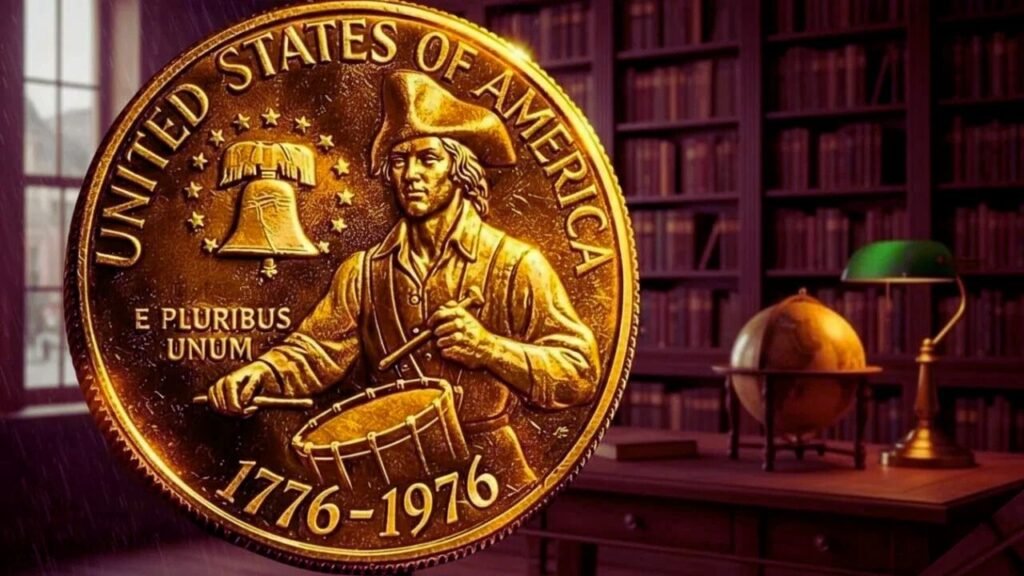
The 1776-1976 Bicentennial Quarter celebrates America’s 200th anniversary with a special reverse design showing a colonial drummer boy. Issued during 1975 and 1976, these quarters come in clad and silver versions, and while most hold only face value, certain silver pieces, rare errors, and top-graded examples can fetch impressive sums from collectors today.
Background on the Bicentennial Quarter
Congress approved a temporary redesign for the quarter, half dollar, and dollar to mark the nation’s bicentennial. The quarter features George Washington on the obverse and the unique drummer boy on the reverse, with the dual date 1776-1976. Production occurred at Philadelphia (no mint mark), Denver (D), and San Francisco (S). Clad versions used a copper-nickel mix for circulation, while 40% silver versions went into proof sets and special uncirculated sets. Over 800 million clad quarters were made, making standard examples extremely common.
Clad vs. Silver Versions and Typical Values
Most Bicentennial quarters you find in change or old jars are clad and worth 25 cents unless they’re in exceptional shape. Silver versions, struck only at San Francisco, carry a premium due to their composition and lower mintage.
Circulated clad quarters generally trade for face value or slightly more if well-preserved. Uncirculated clad pieces start around a few dollars and climb in higher grades. Silver examples hold intrinsic metal value plus collector appeal, often ranging from $5 to $50 in average condition, with proofs adding more.
High-Grade Coins and What Drives Their Worth
Condition plays a huge role in value, especially for modern coins like these. Grading services like PCGS and NGC assign scores on the 1-70 scale, where Mint State (MS) indicates no wear and Proof (PR) means mirror-like finishes from special strikes.
High-grade clad quarters from Philadelphia or Denver can reach hundreds or even thousands in top tiers. For instance, MS68 examples have sold for several thousand dollars in recent auctions. Silver business strikes and proofs perform even better in gem condition, with MS69 silver pieces recording sales near $20,000 in past markets.
- MS65 to MS66 clad quarters often sell for $10 to $50
- MS67 clad examples range from $50 to $200+
- MS68 clad high-grades have fetched $1,000 to $5,000+
- Silver MS68 or PR70 coins command $100 to several thousand
These premiums reflect rarity in pristine preservation, strong luster, and minimal marks.
Notable Errors and Varieties That Boost Value
Minting mistakes turn ordinary coins into sought-after rarities. Bicentennial quarters show several documented errors, from subtle die varieties to dramatic strikes.
Common ones include doubled die obverse (DDO) varieties, where lettering like “LIBERTY” appears doubled, especially on Denver strikes. Off-center strikes, wrong planchet errors (struck on dime blanks), and rotated dies also appear occasionally.
- Doubled Die Obverse (FS-101 or FS-102) on 1976-D: $200 to $1,200+ depending on strength and grade
- Off-center or struck-through errors: $100 to $1,000+
- Major errors like wrong planchet or double denomination: $5,000 to $10,000+ in certified condition
Collectors hunt these in pocket change or old rolls, as even minor examples add excitement.
Tips for Checking and Selling Your Coins
Examine your quarters under good light with a magnifying glass. Look for the mint mark (or lack thereof) below Washington’s neck, check the drummer boy’s details for doubling, and assess overall wear. Silver versions feel heavier and show no copper rim when viewed from the edge.
For potential high-value pieces, consider professional grading to confirm authenticity and condition. Sell through reputable auctions, dealers, or online platforms specializing in coins. Always verify current market trends, as values fluctuate with collector demand and precious metals prices.
The 1776-1976 Bicentennial Quarter remains a popular piece of American history. While the vast majority stay at face value, the right combination of silver content, error, or superb grade can transform a 25-cent coin into a valuable collectible. Careful inspection might reveal a hidden gem in your collection.
FAQs
Are all 1776-1976 Bicentennial Quarters valuable?
No, most clad circulation strikes are worth only 25 cents unless in high grade or with errors.
What makes a high-grade Bicentennial Quarter worth thousands?
Pristine condition with minimal marks, strong luster, and top MS68 or MS69 ratings from PCGS or NGC drive the highest prices.
Are there any rare errors worth looking for?
Yes, doubled die varieties on the obverse, off-center strikes, and wrong planchet errors can significantly increase value.
Should I get my quarter graded if it looks nice?
If it’s uncirculated or shows potential errors, professional grading can confirm value and make it easier to sell at peak prices.